Two separate but interrelated subjects — when to sow and how to water — determine much of what happens in a Polish kitchen garden between February and October. This article covers both: a growing calendar based on average last-frost dates for central Poland, and a comparison of the irrigation methods most commonly used in allotments and backyard plots.
Understanding Polish climate zones for gardening
Poland's continental climate produces cold winters and warm-to-hot summers with variable spring arrival. The average last frost date varies significantly by region: early April in southern lowlands near Wrocław and Kraków, mid-April across the central Mazovia plateau, and late April in northeastern Podlachia and Warmia-Masuria. Using the last frost date as a reference point anchors sowing decisions more reliably than calendar month alone.
Summer drought periods have intensified in the past decade. July and August now regularly record rainfall deficits of 40–60 mm below the long-term average in central and eastern Poland, according to data from the Institute of Meteorology and Water Management (IMGW). This shift makes reliable irrigation a practical necessity rather than an optional enhancement for many vegetable crops.
Month-by-month growing calendar
February — indoor sowing
Celery and celeriac are the first seeds to start indoors, requiring 10–12 weeks before transplant. Sow in trays under grow lights or on a bright south-facing windowsill at 18–20°C. Onion seeds started in February allow transplanting as small plants rather than sets, which some growers find produces better-keeping bulbs.
March — early indoor sowing
Tomatoes, peppers and aubergines go into modules or small pots in the first two weeks of March. These need consistent warmth (20–24°C) for germination. Leeks can be started alongside them. By the end of March, early lettuce and spinach can be sown directly outdoors under a low tunnel or fleece — both tolerate ground frost down to –5°C once established.
April — main cold-hardy direct sowing
Parsnips, broad beans, carrots, beetroot, radish, and pak choi are sown directly from mid-April onward once soil temperature at 5 cm depth consistently reaches 7°C. Brassica seedlings started in February (kale, cabbage, broccoli) can be transplanted out under fleece protection in the third week of April in central Poland.
May — last frost passes; full outdoor sowing
After the last frost — typically between 5 and 15 May for central Poland — all frost-tender crops go in: courgettes, cucumbers, climbing beans, runner beans, squash and sweet corn direct-sown outdoors. Tomatoes and peppers transplant outdoors after hardening off for 7–10 days. Basil follows at the end of May; it collapses at soil temperatures below 12°C.

June and July — successional sowing
Successional sowing of lettuce, radish, turnip and spring onion every three weeks extends harvests through September. A second sowing of carrots in late June produces an autumn crop less prone to carrot fly attack than the early sowing. French beans can be sown again in late June for harvest into September.
August — autumn sowing begins
Winter radishes, kohl rabi, autumn cabbages and Chinese cabbage go in during the first two weeks of August. Spinach sown in late August overwinters successfully in central Poland under a cold frame and restarts growth in February. Garlic cloves planted in the last week of August or first week of September establish strong root systems before winter and produce larger bulbs than spring-planted garlic.
September and October — harvest and cleanup
Main-crop potatoes, beetroot, carrots and parsnips are lifted and stored before the first hard frost. Leeks and kale remain in the ground and can be harvested as needed through winter. Beds cleared of summer crops benefit from an immediate dressing of compost (3–4 cm) left on the surface over winter — worms incorporate it by spring.
Watering systems compared
Overhead watering: watering cans and sprinklers
The most common method in allotment gardens is still the watering can or oscillating sprinkler. Both are inexpensive and require no installation. The disadvantage is significant: overhead watering wets foliage, which promotes fungal diseases in tomatoes, cucumbers and courgettes. It also delivers water to path areas and between rows where it encourages weed germination. In dry conditions, much of the water evaporates before reaching root depth. For a garden relying on this method, watering in the early morning reduces evaporation loss compared with afternoon application.
Drip irrigation
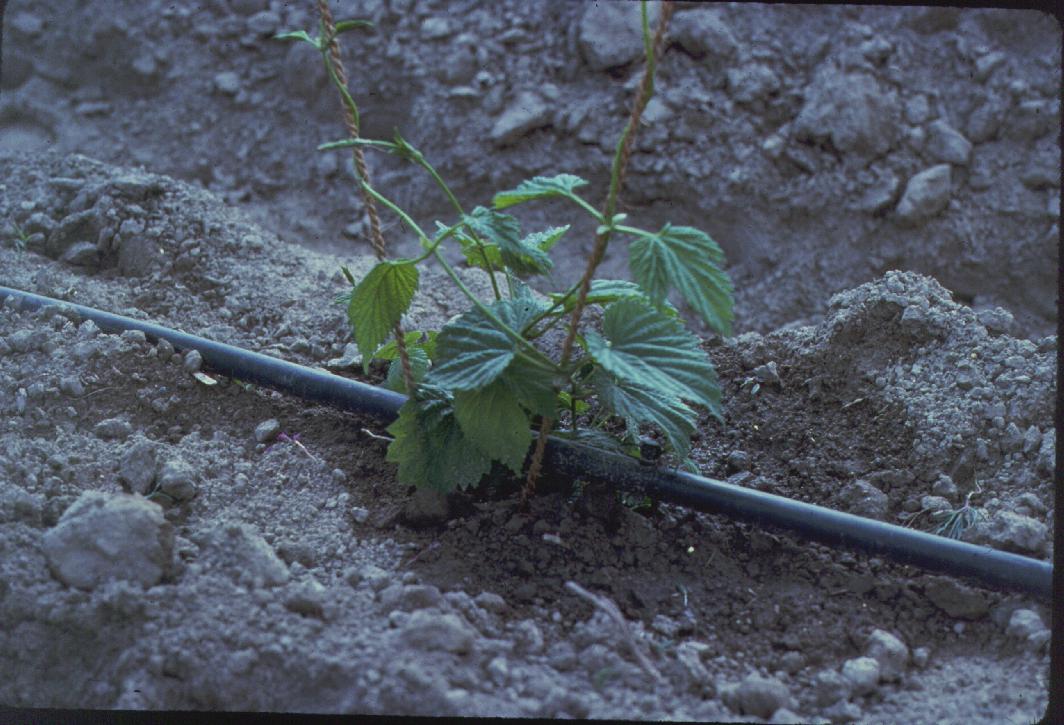
Drip systems deliver water directly to the root zone through emitters spaced along supply lines. Water use is 30–50% lower than overhead methods for equivalent plant growth, according to comparative trials cited by the Food and Agriculture Organization. Installation for a 30 m² raised bed plot requires: a pressure regulator (essential for mains-connected systems to avoid bursting the lines), a filter to prevent emitter clogging, a main supply line (16 mm), branch drip lines (8–13 mm) and emitters at 20–30 cm spacing. Complete kits for small plots are available from Polish garden suppliers at 80–200 PLN depending on coverage area.

Soaker hoses
A soaker hose is a porous rubber or recycled-tyre tube that weeps water slowly along its entire length. It is less precise than drip emitters — water distribution can be uneven on slopes — but easier to install and harder to block with mineral deposits. Soaker hoses work particularly well along rows of beans, brassicas and beetroot where uniform moisture is more important than crop-specific targeting. They should be covered with a 5–8 cm layer of mulch (straw or wood chip) to reduce surface evaporation, which otherwise negates much of the water-saving advantage.
Timer systems
Battery-operated tap timers costing 60–120 PLN allow any drip or soaker system to operate on a fixed schedule without manual intervention. The most useful setting for Polish summer conditions is two short irrigation sessions — early morning and early evening — of 20–30 minutes each rather than a single long daily run. Short sessions reduce runoff on sloped surfaces and allow the soil to absorb water before the next application. Timers with soil moisture sensors are available at higher price points (250–500 PLN) and automatically skip irrigation cycles when soil moisture is adequate — a worthwhile investment for gardeners who travel.
Water sources in Polish allotments
Many Polish allotments (działki ROD) have communal water points with metered supply. Rainwater collection from shed roofs is an increasingly common supplement: a 200-litre butt fed by a 4 m² roof section collects approximately 2,400 litres annually in central Poland based on average rainfall data. Connecting multiple butts in series extends storage capacity without additional cost beyond fittings. Collected rainwater carries no chlorine and has a slightly acidic pH (5.5–6.5) that acid-tolerant crops such as tomatoes and blueberries find agreeable.